
TL;DR
- Adding schema markup helped AI models cite a page by the same amount as adding the same fact in a plain sentence. Both took citations from 70% to 95%.
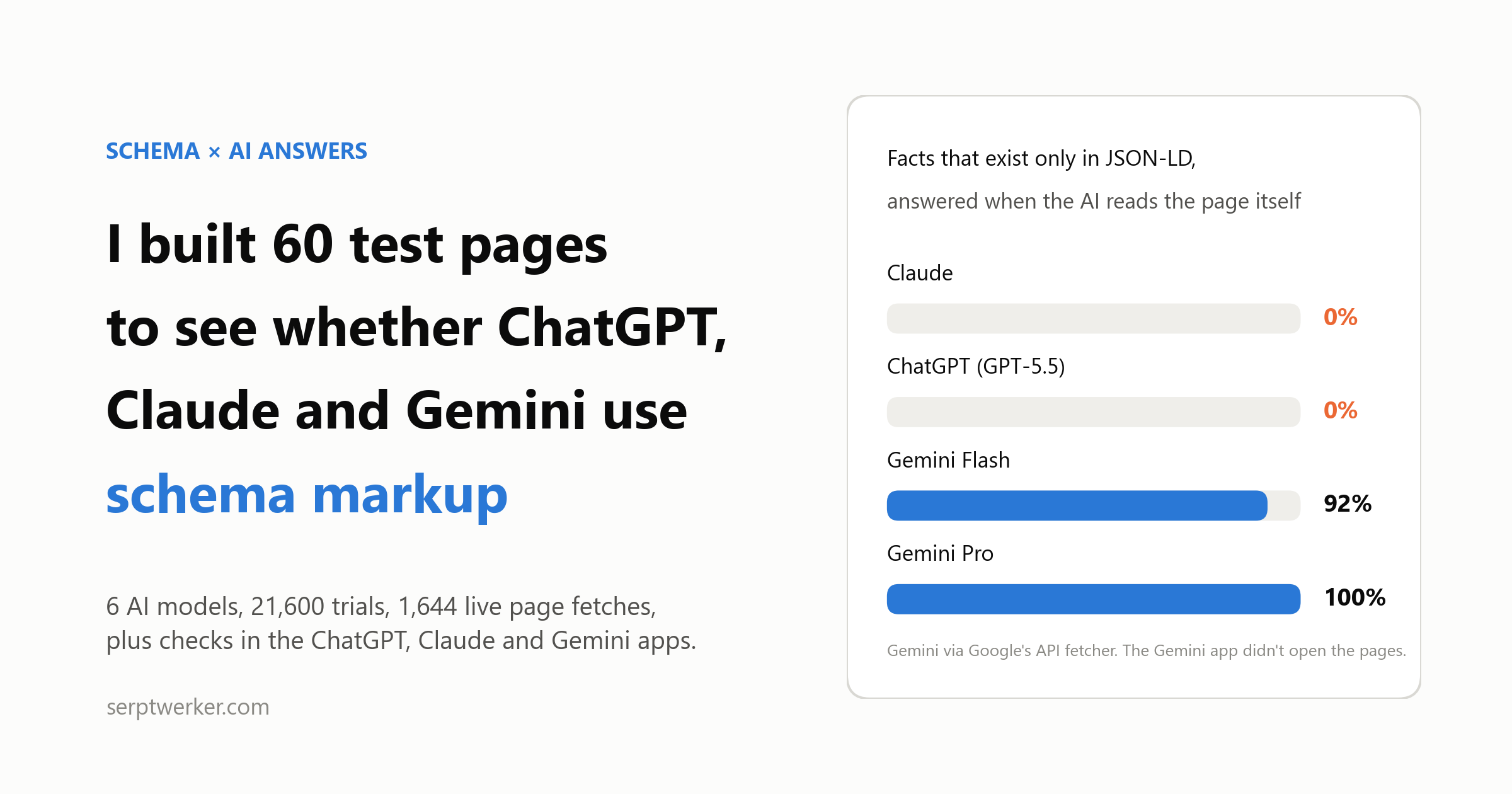
- When ChatGPT and Claude read a page live, their fetchers strip out the JSON-LD. Facts that existed only in schema were answered 0% of the time, in the APIs and in the apps.
- Google’s API fetcher passes JSON-LD through, so Gemini answered those facts 92% (Flash) and 100% (Pro) of the time. The Gemini app didn’t open the pages at all.
- Claude was the only model that discounted broken markup. It used schema-only facts 96% of the time from valid JSON-LD and 56% from broken JSON-LD, while GPT-5.5 and Gemini used them either way.
- When the page and the schema disagree, the big models trust the page. The exception was Gemini Pro reading FAQPage pages through Google’s fetcher, which picked the stale schema answer 8 times out of 20.
- If you want AI systems to use a fact, put it in visible text, and keep your schema valid and matching the page.
Contents
- Why I ran this test
- How I tested it
- Finding 1: schema gives the same lift as prose
- Finding 2: only Claude hesitates over broken markup
- Finding 3: when body and schema disagree, the big models trust the body
- Finding 4: ChatGPT’s and Claude’s fetchers drop your JSON-LD
- Finding 5: the consumer apps behave the same way
- Finding 6: Gemini Pro’s one slip
- The layer I couldn’t test: getting indexed
- So who was right?
- What I’d do with your schema
- Limits
Why I ran this test
In February, Mark Williams-Cook published a small, clever experiment. He built a page for a fake t-shirt company, “DUCKYEA”, and put its address only inside a made-up JSON-LD block, with a nonsense @context and an invented @type. When he asked ChatGPT and Perplexity, both returned the address. His read was that schema is treated like any other text, not something these systems use as intended. He credits Richard Barrett with running the test first.
The post went everywhere, and so did the pushback. Some people said one page and one run, with nothing to compare against, proves nothing. Olivier de Segonzac of RESONEO pointed to his crawler study, which found that the live fetchers ChatGPT, Claude and Gemini use when a user asks about a page don’t extract JSON-LD from script tags. In the comments on Mark’s post he added that he couldn’t reproduce Mark’s ChatGPT result. In the same thread, Mark McNeece suggested the AI sometimes does a web fetch and sometimes a plain request, and only one of them exposes the page source. And Jake Hundley‘s study of 29 local-business sites found that schema didn’t help search rankings but did improve ChatGPT positions by about three places, the one surface where it saw a lift.
Everyone was arguing from single screenshots, or from whole-site studies that can’t separate the model from the crawler, the index and everything else that changed on the site. So I built a controlled version.
How I tested it
Every test page describes a fictional company and carries one fact a user might ask about: a price, a product spec, an address, an author or a publication date. Because the companies are invented, a correct answer can only have come from my page.
Each fact appears in five versions of the page:
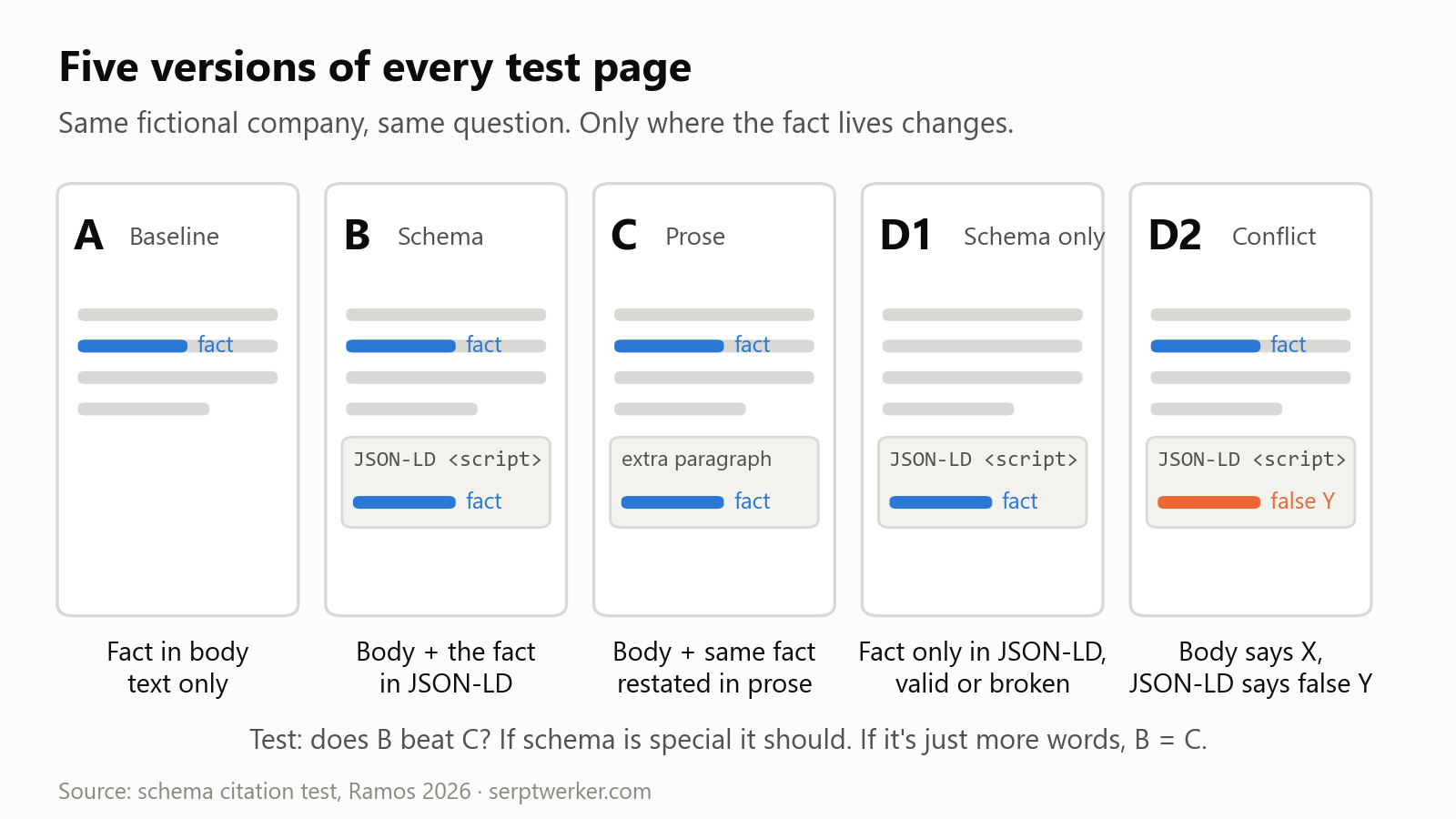
Version C is the control Mark’s experiment was missing. It adds the same fact as an extra sentence of prose, matched in length to B’s JSON-LD. If schema has some special power, B should beat C. If schema is just more words, they should come out the same. Version D1 repeats Mark’s hidden-address test, with both valid and deliberately broken markup, and D2 asks what happens when the page contradicts itself. Every version also comes in two schema types, Article and FAQPage. Five facts, two schema types and six variants (D1 counts twice, valid and broken) make the 60 test pages.
Schema can win or lose at three points on its way to an AI answer, and I tested each one separately:
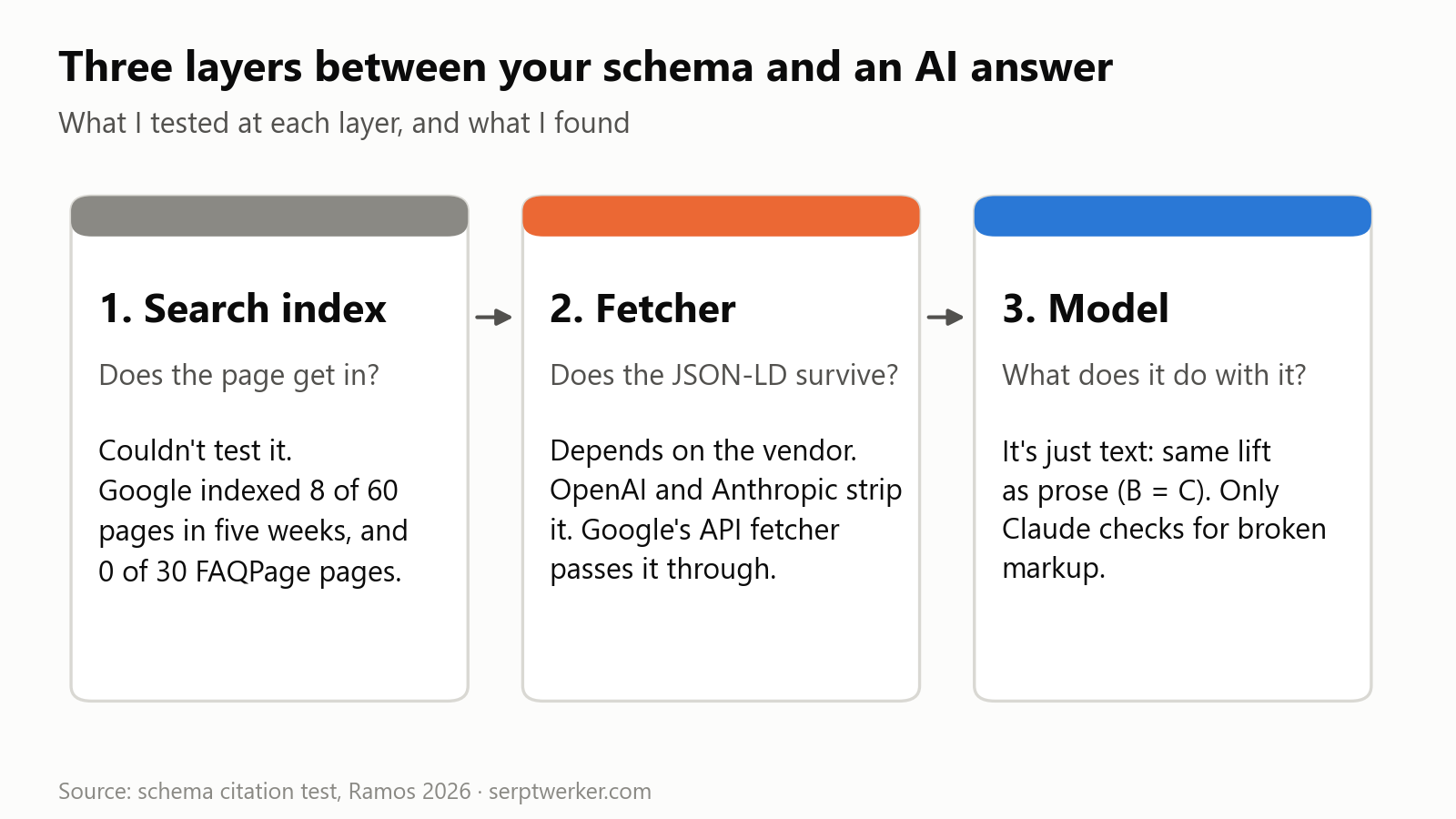
- The model. I built the retrieval step myself and handed six models the pages, JSON-LD included: Claude Sonnet 5, GPT-5.5, Gemini Flash, Gemini Pro, and two open models running locally (Gemma 3 12B and Phi-4 14B). Each model answered the same questions over the same small corpus, with the same retriever. That came to 21,600 trials, analyzed with a mixed-effects model that accounts for differences between questions and between models.
- The fetcher. I gave the four hosted models the live URL of every test page and had them read it with their own vendor’s web tool: Claude’s web fetch, GPT-5.5’s web search, and Gemini’s URL context. Retrieval drops out here, because I name the page. That was 1,644 live fetches. Then I repeated a subset by hand in the ChatGPT, Claude.ai and Gemini apps, another 90 queries.
- The search index. The plan was to wait for the pages to be indexed and see which ones AI search products cite. Google’s indexing stopped that part of the test.
Finding 1: schema gives the same lift as prose
On the body-only pages (A), models cited the right page 70% of the time. Adding JSON-LD (B) took that to 95%. Adding the same fact as a plain sentence instead (C) also took it to 95%.
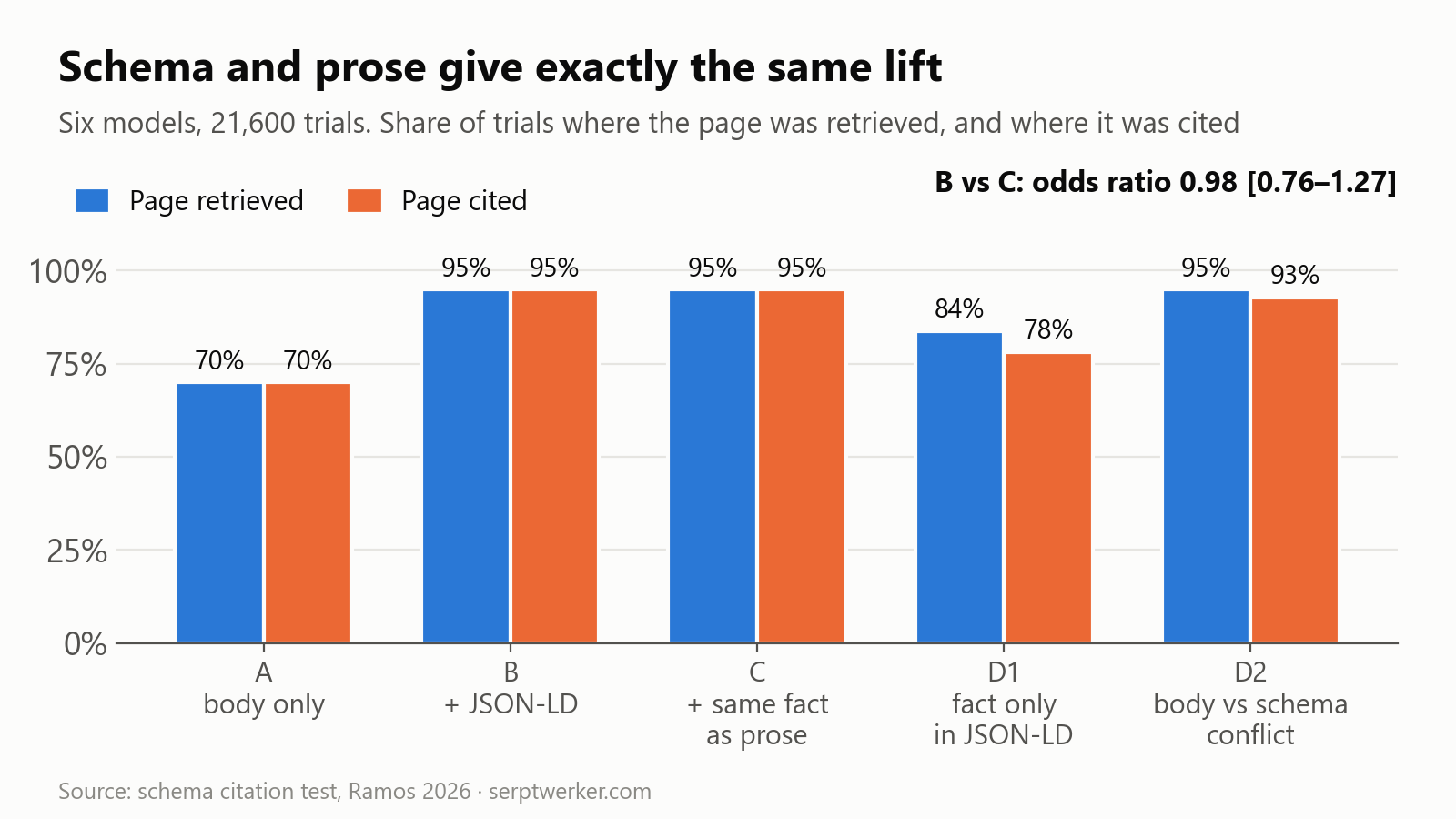
B versus C is a dead heat: odds ratio 0.98 (95% CI 0.76 to 1.27, p = 0.90). The gap was zero on five of the six models, and 0.2 points on the sixth.
The chart also shows why. The blue bars (was the page retrieved?) and the orange bars (was it cited?) track each other almost perfectly. Restating a fact gives the retriever more matching words, so the page gets pulled into the model’s context more often, from 70% to 95%. Once a page is in context, it gets cited nearly every time, whichever version it is. The lift is real, but it comes from retrieval, and JSON-LD and prose produce the same amount of it.
Splitting by schema type shows the same mechanism. On Article pages, the target page was retrieved for 18 of the 20 questions with JSON-LD and 19 with prose. On FAQPage pages, JSON-LD got all 20. FAQPage markup repeats the question word for word (“What is the registered office address of…”), so it hands the retriever an exact match. That’s also why FAQPage pages were cited more overall (odds ratio 5.47 against Article pages, 95% CI 4.8 to 6.2). The body text was the same for both, and the gap only appears where JSON-LD is present. The boost comes from words that match the question, not from the markup being schema.
Local and hosted models didn’t differ either (odds ratio 1.15, p = 0.67), so I treat the six models as one result.
So on the narrow question, Mark and everyone arguing that schema is just text are right. At the model level, schema is text.
Finding 2: only Claude hesitates over broken markup
Mark’s experiment tested something more specific than whether schema helps: whether a model will take a fact from markup that is obviously broken. Here the models split.
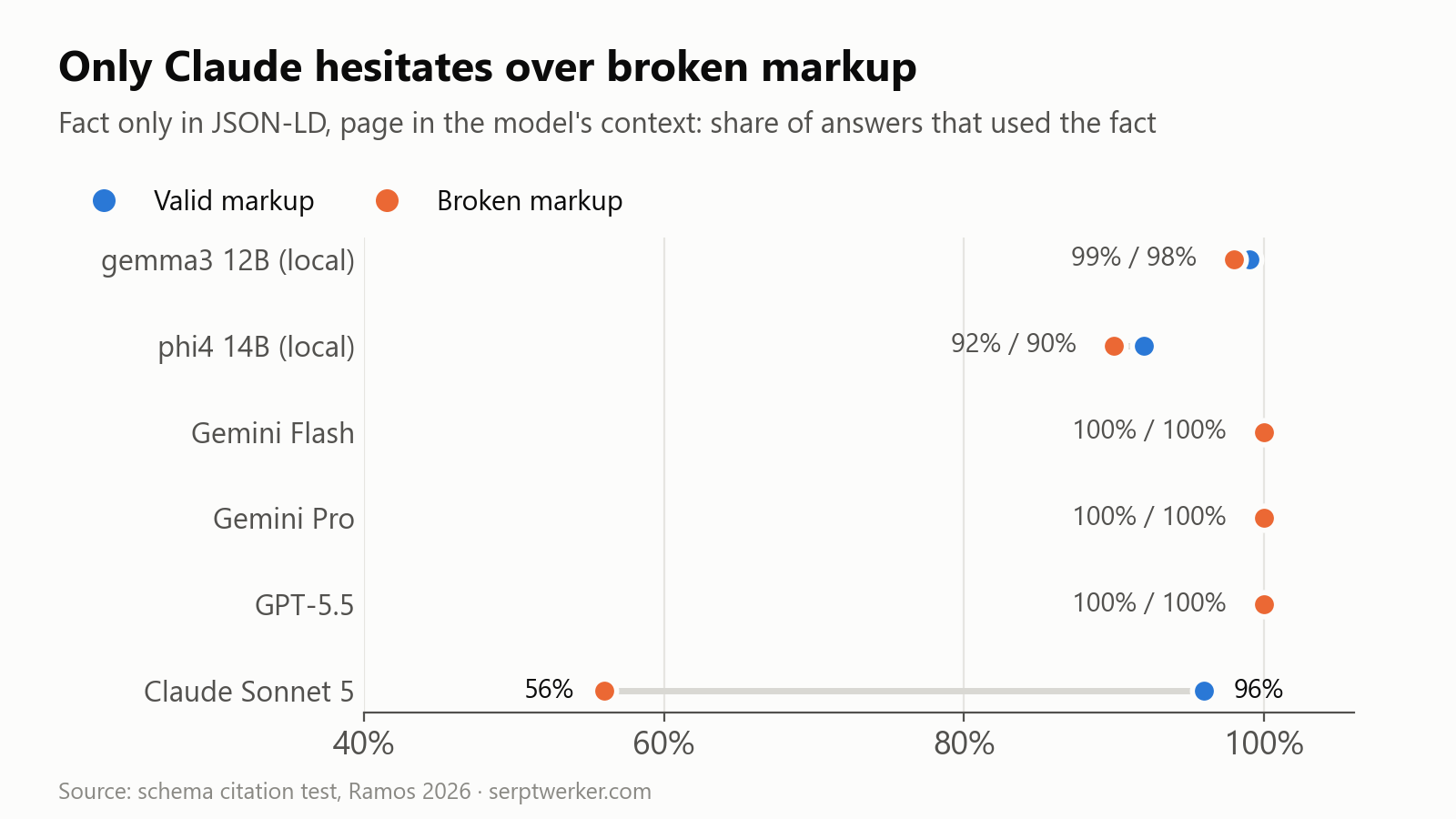
When the page was in context and the fact lived only in the JSON-LD, GPT-5.5 and both Gemini models used it every time, valid or not. So did the two small local models. Only Claude noticeably hesitated over nonsense markup: it used the fact 96% of the time with valid JSON-LD and 56% of the time with broken JSON-LD. Counting every D1 trial, including ones where the page wasn’t retrieved, Claude’s gap is 32 points (95% CI 25 to 38). Every other model’s gap is close to zero.
Model size doesn’t explain this, since Gemini Pro checks no more than Gemini Flash does. It looks like a difference between vendors. So the claim that validity doesn’t matter holds for the surfaces Mark tested, and doesn’t hold for Claude.
Finding 3: when body and schema disagree, the big models trust the body
On the conflict test (D2), the four hosted models agree with each other and part ways with the small ones.
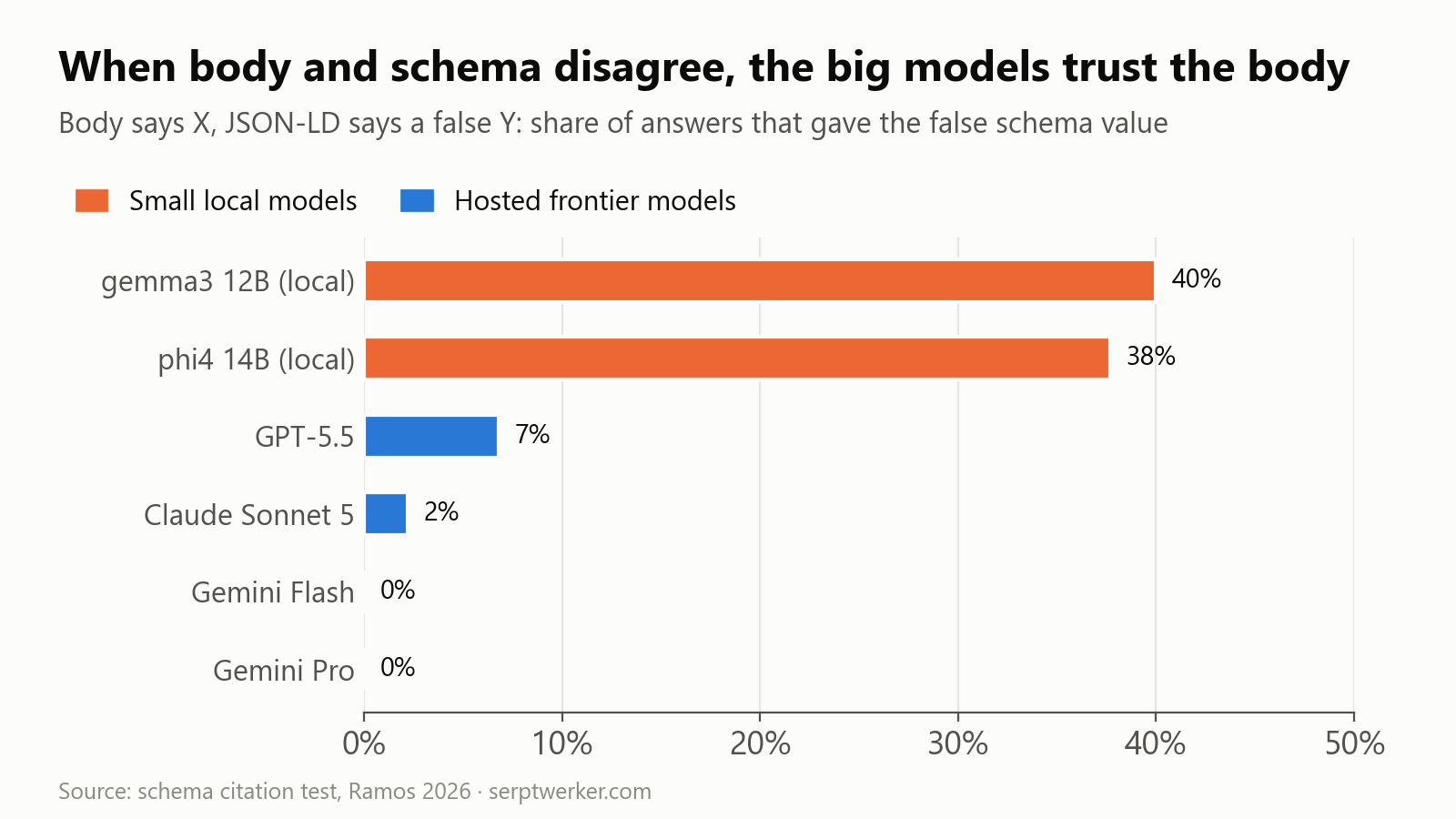
When the body says one value and the JSON-LD says a different, false one, the hosted models went with the body 88% to 94% of the time and with the false schema value at most 7% of the time. The two small local models took the false schema value about 40% of the time.
Put findings 2 and 3 together and you get a split that explains a lot of the argument online. GPT-5.5 and Gemini won’t let false schema override the visible text, but when nothing on the page contradicts it, they don’t check the schema either. They take the markup at face value.
Finding 4: ChatGPT’s and Claude’s fetchers drop your JSON-LD
The first three findings are about what a model does with schema once it has it. In those runs my own code built the context, so the JSON-LD always arrived. That’s the gap de Segonzac’s crawler study points at: if the fetcher strips script tags, the JSON-LD never reaches the model. It ended up mattering more than anything else I tested.
So I gave each hosted model the live URL of every test page and let its own web tool fetch it. The fetchers opened the exact URL in all but 4 of 1,644 tries (1 for Gemini Flash, 3 for Gemini Pro), and I left those 4 out of the scoring. On the pages with no conflict, every model answered facts that were in the body text 100% of the time. Each page also got a question the page doesn’t answer, and in 234 of those tries no model made up a value, so the 0% and 100% results below aren’t guesses. Then I looked at the D1 pages, where the fact is only in the JSON-LD:
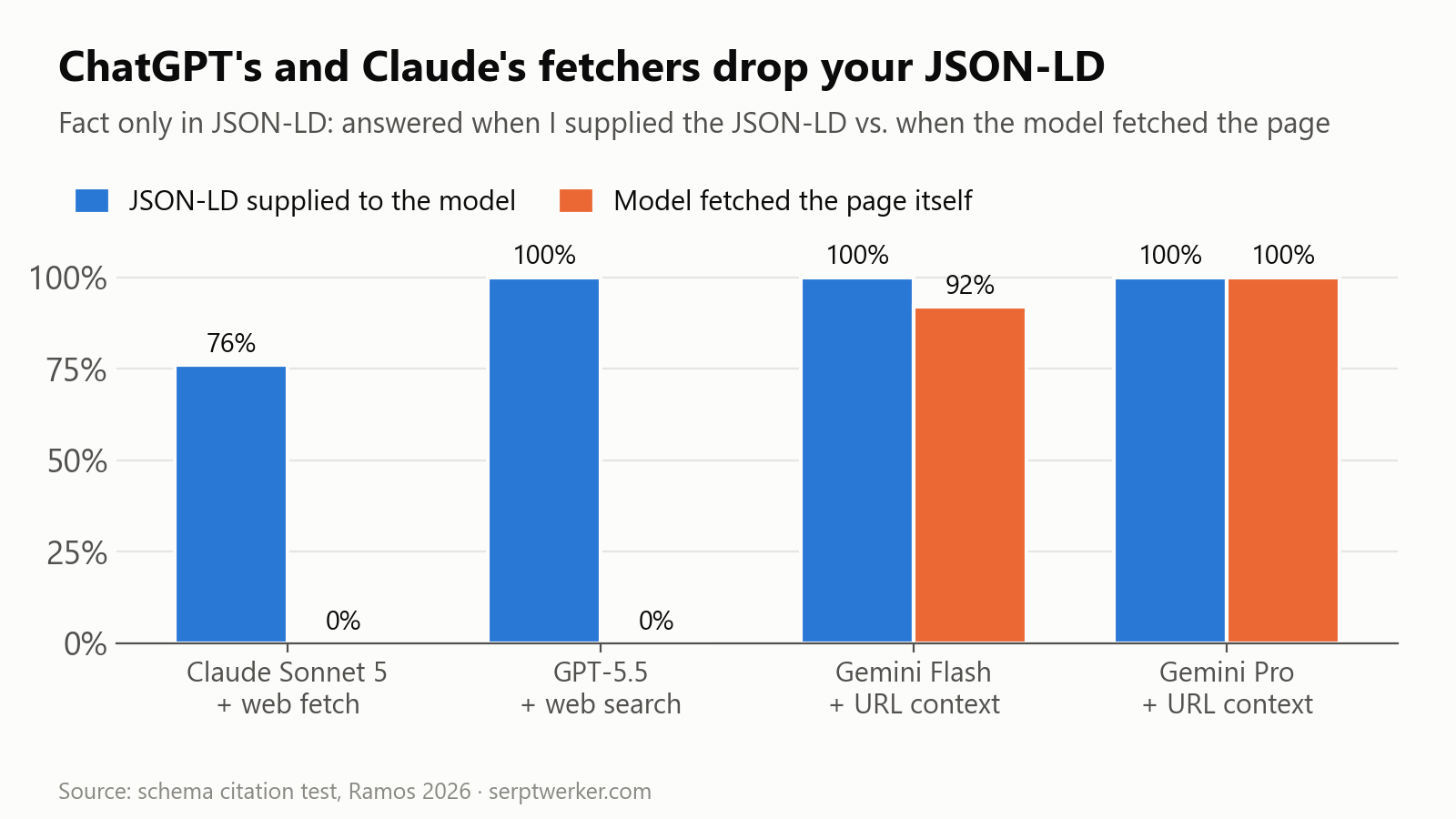
Claude with web fetch answered 0 of 100. I don’t have to take the model’s word for that: Anthropic’s tool returns the document it fetched, and of 280 fetched pages that carried JSON-LD, not one still contained it. The page comes back as markdown with the script content gone.
GPT-5.5 with web search also answered 0 of 100. OpenAI’s tool doesn’t show what it fetched, so I’m relying on the model’s own report here. It said it saw no structured data on any page, which fits with it never answering a schema-only fact.
Gemini Flash with URL context answered 92 of 100, and Gemini Pro 89 of 89 (its run was cut short, see Limits). Google’s fetcher passes the JSON-LD through as text, and both models quote it back, including the invented @type from my broken pages, which they couldn’t have guessed. Neither claimed to see schema on pages that have none. Flash was slightly pickier through its fetcher than when I supplied the JSON-LD directly: it used 50 of 50 facts from valid markup and 42 of 50 from broken markup. That’s a small sample, so I’d treat it as tentative.
So the script-stripping crowd is right about OpenAI’s and Anthropic’s fetchers. Through those tools, a fact that lives only in JSON-LD never arrives, and Claude’s care with broken markup never gets a chance to matter. Google’s API fetcher does the opposite and hands the JSON-LD straight to the model, so anything built on it inherits Gemini’s habit of reading everything, broken markup included.
Finding 5: the consumer apps behave the same way
Most people don’t use the APIs, so I repeated the test in the consumer apps. I used 15 pages: the 10 schema-only Article pages (every fact type, valid and broken markup) and 5 pages with the fact in both body and JSON-LD. Each one got a fresh temporary or incognito chat, the app’s default model, and the same two prompts as the API runs: answer the question from the page, then say whether the page contains structured data.
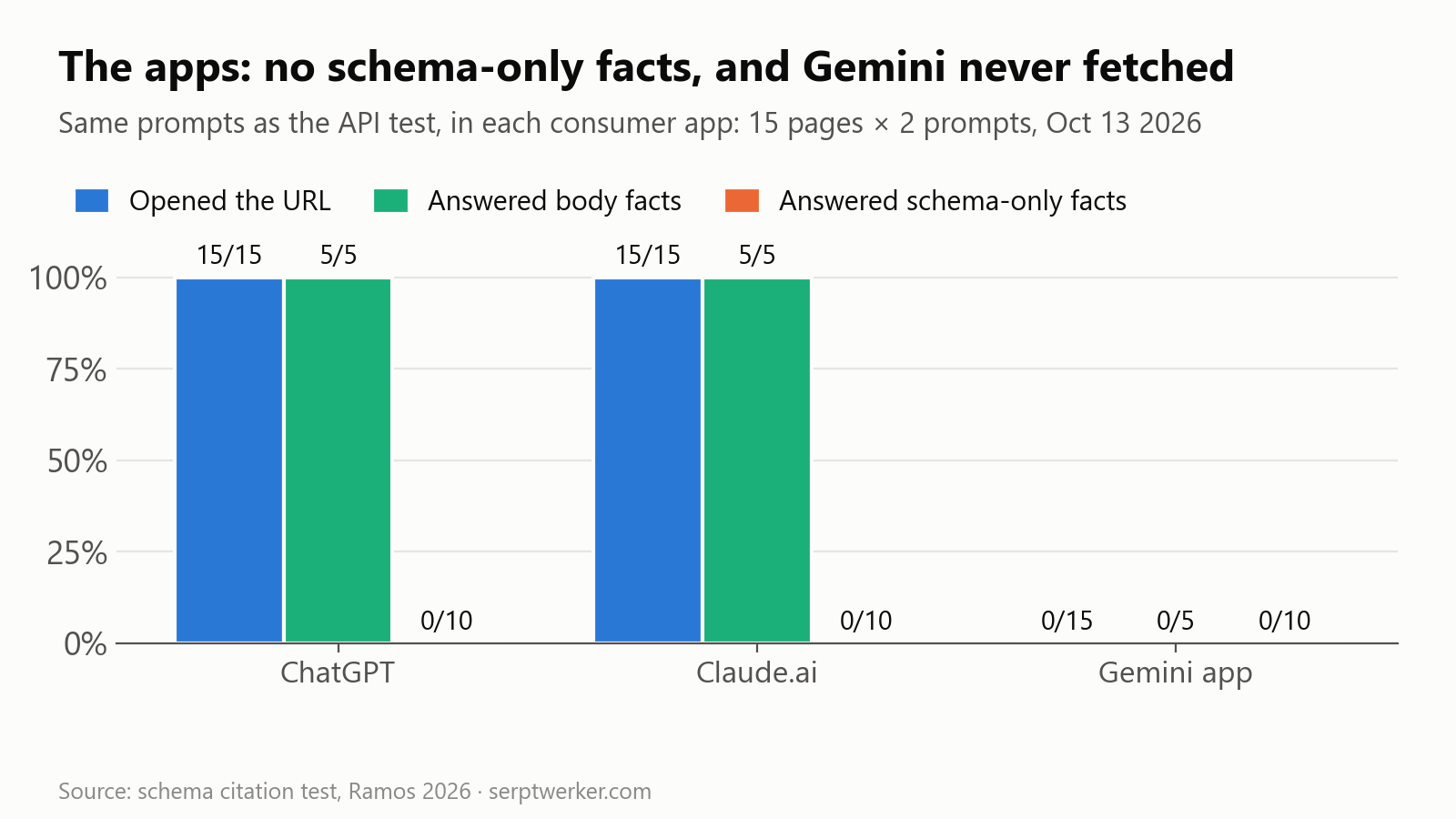
ChatGPT opened every page and answered all 5 body facts. It answered none of the 10 schema-only facts (“the page does not state…”) and reported no structured data on any of the 15 pages, including the 5 that carry JSON-LD. Claude.ai gave the same results. Its default model was Opus 5.5 rather than the API’s Sonnet 5, but since the JSON-LD never arrives, the model doesn’t matter here.
The Gemini app never opened a page. All 30 replies said the page “could not be retrieved”, including pages Google has indexed, and it showed “Searching the web” instead of reading the URL. So the app I tested (default Flash model, temporary chat) doesn’t do the live read that Gemini’s API tool does. In the app, what Gemini knows about your page comes from search.
So what about Mark’s result? He saw ChatGPT return a schema-only address in February. Neither the ChatGPT app nor its API fetcher saw my JSON-LD, and de Segonzac couldn’t reproduce Mark’s result either. That doesn’t make Mark wrong about what he saw. ChatGPT may have fetched pages differently in February, and McNeece’s point that the fetch path can vary would explain a one-off. I just didn’t see any variation: ChatGPT and Claude never saw JSON-LD once, in the API runs or the apps. On the evidence I have, a fact that lives only in JSON-LD doesn’t reach ChatGPT when it reads your page live.
Finding 6: Gemini Pro’s one slip
The most practical finding is a Gemini one. On the conflict pages, every model stuck with the body text when it fetched the page itself, except Gemini Pro on FAQPage pages.
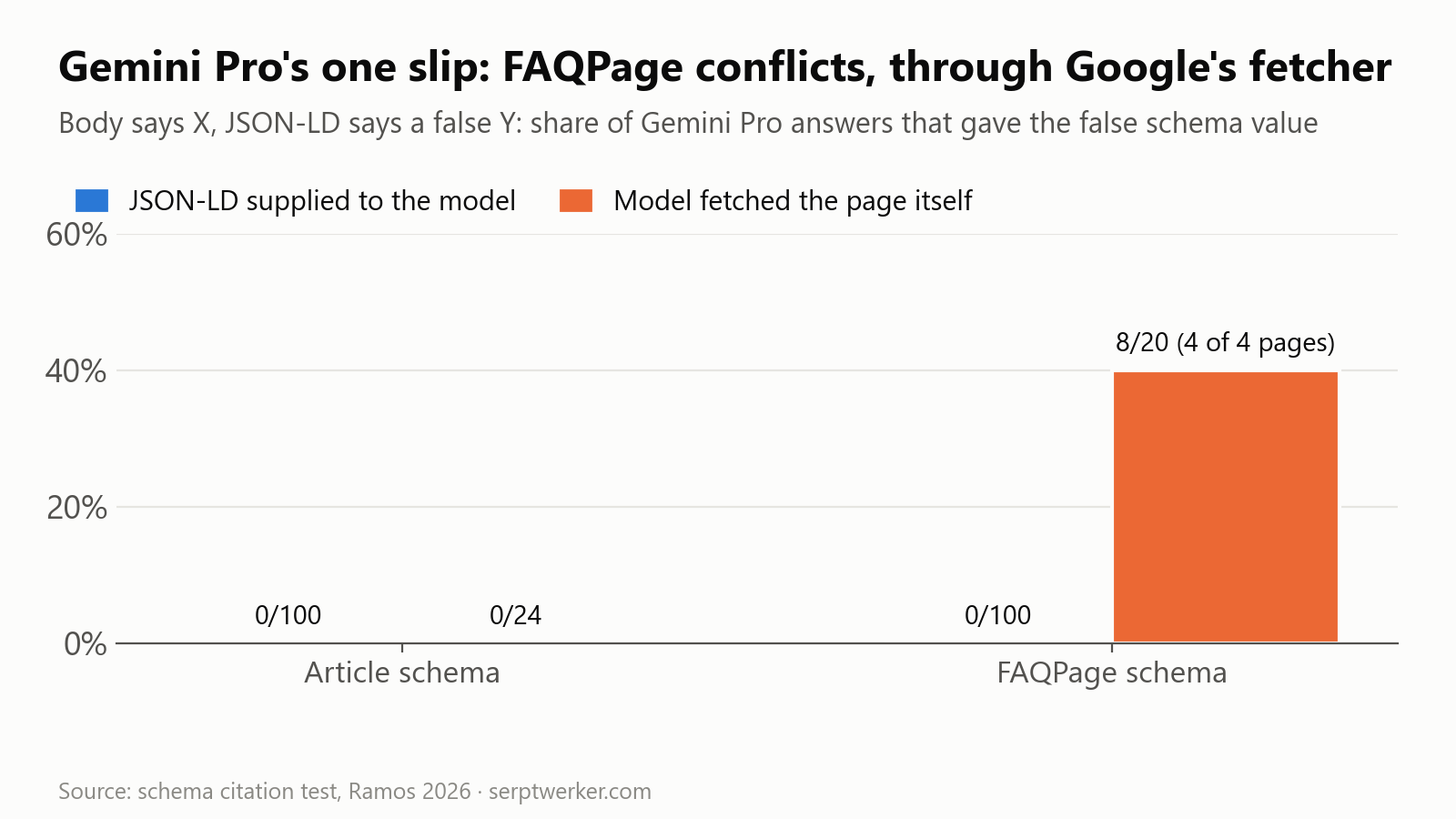
Through Google’s fetcher, Gemini Pro took the false schema value on 8 of 20 FAQPage tries, spread across all four FAQPage conflict pages, and never on Article pages (0 of 24). A few times it even pointed out the conflict, naming the value “in the FAQ schema” and the one “in the main text”, and then picked the FAQ answer anyway.
When I gave Pro the same JSON-LD directly, it never did this (0 of 100). So the behavior comes from how Google’s fetcher presents FAQPage markup, not from the model alone. My guess is that FAQ question-and-answer pairs read like page content once they come through that pipeline, but I haven’t tested that. It’s also a small sample, four pages tried five times each, so I’d read it as a warning sign rather than a rate.
The advice that follows from it is still clear: if you use FAQPage schema, keep it identical to what’s on the page. A stale FAQ answer in your markup can beat your visible text in Gemini.
The layer I couldn’t test: getting indexed
The plan had a third layer: wait for the test pages to be indexed, then ask AI search products questions and see which pages they cite. Google didn’t index enough of them for that.
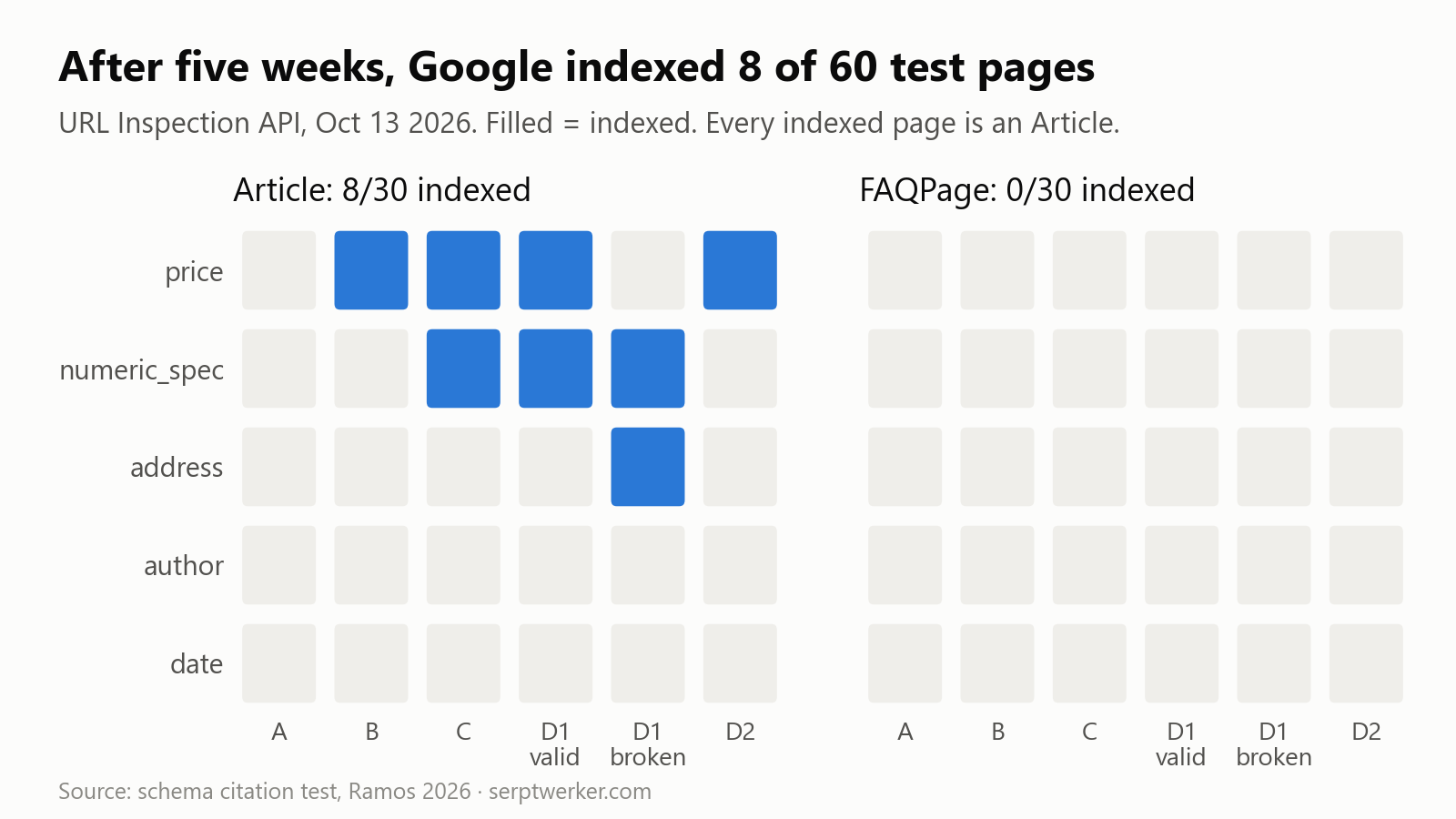
After five weeks, a submitted sitemap and two rounds of Google Indexing API requests, Google indexed 8 of the 60 test pages. All 8 are Article pages. None of the 30 FAQPage versions is indexed, and neither is any author or date page. Googlebot hasn’t fetched a test page since September 20, even though it crawled the site’s homepage on October 12.
I did run the direct test on the 8 pages that got in. I asked ChatGPT search and Claude with web search each page’s question, without giving the URL, for 16 queries in all. Neither one cited my page or gave the fact a single time. Eight indexed pages, all Article and none of them FAQPage, aren’t enough to compare schema versions, so from 0 of 16 I can only say that being indexed didn’t get these pages into answers.
With that pattern there’s no fair comparison to make, so I’m reporting it as a limit rather than a result. It’s also a warning for anyone planning their own test, because thin, templated test pages, with fake information, on an unoptimized, low-authority domain may never get in. Hundley’s study used real business sites, which is one way around that, at the cost of not being able to separate schema from everything else on the site.
So who was right?
Mostly everyone, about different layers.
| Position | Verdict |
|---|---|
| Schema is treated like any other text (Williams-Cook) | Right, at the model level. JSON-LD and the same words in prose had the same effect. |
| One page with no control group proves nothing | Fair criticism. With the control in place, the just-text conclusion holds. |
| Schema validity doesn’t matter | Depends on the model. True for GPT-5.5 and Gemini, false for Claude. |
| Live fetchers strip script tags, so JSON-LD never arrives (de Segonzac) | Right for OpenAI and Anthropic, in both the APIs and the apps. Wrong for Google’s API fetcher, which passes JSON-LD through. The Gemini app didn’t read pages live at all. |
| The fetch method varies between runs (McNeece) | Not in my runs. ChatGPT and Claude never saw JSON-LD once. That doesn’t rule out variation at other times. |
| Schema lifts ChatGPT positions (Hundley) | Not through the model reading it, because ChatGPT’s live fetch doesn’t deliver JSON-LD. A real lift would have to come from somewhere else: retrieval, a search index that parsed the markup, or other changes made to the site at the same time. |
What I’d do with your schema
- Put every fact you care about in visible text. It’s the only place all three vendors reliably read it, and for two of the three vendors’ fetchers it’s the only thing that gets through at all.
- Don’t expect JSON-LD to do more than a sentence would. Its retrieval boost is real, but writing the fact down plainly gives you the same boost.
- Keep markup and page in sync, especially FAQPage. The big hosted models mostly trust the body when the two disagree, but Gemini Pro took the stale FAQ answer 8 times out of 20 through Google’s fetcher.
- Keep it valid anyway. Claude discounts facts from broken markup when it sees them, and valid markup costs you nothing.
- Don’t throw schema out. I tested whether models use JSON-LD to answer questions. I didn’t test rich results, Google’s Knowledge Graph, or how search indexes use structured data before AI products ever see it. Those are different jobs, and this study says nothing about them.
Limits
The companies are fictional and each page carries one fact. Real pages with many facts and well-known brands should behave differently.
I tested the model layer through APIs. I tested the fetch layer through APIs too, then spot-checked it in the apps with one run of 30 prompts per app, so the app numbers are small. The Gemini app result comes from one model (Flash) in temporary-chat mode, and other modes or models might fetch.
For GPT-5.5 and Gemini, whether the JSON-LD arrived is the model’s own report. Only Claude’s tool shows the fetched text. In both directions, the self-reports line up with what the models answered.
Gemini Pro’s fetch run stopped at 384 of 420 trials after repeated API errors on October 14. Its fetch numbers rest on about 44 trials per page version instead of 50, and its FAQPage conflict result on 4 pages instead of 5.
Hosted models change. These runs were in September and October 2026, and Gemini Pro was a preview model (gemini-3.1-pro-preview). The search layer only got 16 direct queries on 8 indexed pages, which is too few to compare schema versions.
Method and data
Design, prompts, trial counts, model versions and the statistical model are in the methods appendix.
Thanks to Mark Williams-Cook and Richard Barrett for the original test, and to everyone in the comment threads whose objections shaped the design.
Leave a Reply