
Multi-brand Domain Consolidation
Shopify domain migration with zero organic traffic loss.
Overview
Two brands. Same parent company. Same Shopify instance. Same URL structures. The business wanted to sunset one brand and fold everything into the surviving primary domain. About 6,200 URLs across both sites, split between product pages, collections, and editorial content. I led the technical SEO side of this from start to finish.
The problem
Domain consolidations sound simple on paper. One domain goes away, the other absorbs it, you set up redirects, done. Except it is never that clean.
Search engines have to reprocess thousands of redirect signals and figure out where to reassign all that ranking equity. That takes time, and during the transition, rankings can swing wildly or just disappear. The sunset brand had its own organic footprint: branded queries people were actively searching, backlinks pointing to pages that were about to stop existing, indexed pages pulling in traffic every day. If the redirects did not land right, all of that just evaporates. And the surviving domain still has to hold its own rankings while absorbing all this new signal. You can easily end up in a situation where both brands lose instead of one brand gaining.
The business set a clear target: zero organic traffic or ranking loss. No wiggle room there.
Strategy
I owned the entire technical SEO scope. Pre-migration analysis, redirect mapping, staging validation, launch-day QA, post-launch monitoring. The dev team handled implementation. Everything else was mine.
I built this around a four-week timeline, which honestly felt tight but worked because the migration itself was technically straightforward (same platform, same URL patterns).
Week 1 was all about establishing a baseline. I crawled both domains with Screaming Frog, pulled exports from GSC and GA4, captured ranking snapshots, and built the redirect mapping spreadsheet. I prioritized the top 200 URLs by organic traffic. Those pages carried the bulk of the search equity, so they got the most attention.
Week 2 I moved to staging validation. Dev team deployed the redirects in staging, and I went through and validated that redirects actually worked, pages loaded correctly, nothing was looping or 404ing. I also put together a baseline benchmark report, the reference document we would compare against post-launch.
Week 3 was the crawlability and indexability audit on the surviving domain. Robots.txt, XML sitemap, canonical tags, GSC verification, indexation status. The canonicals were the thing I was most careful about. You need self-referencing canonicals on everything, and absolutely zero cross-domain canonical references back to the sunset brand.
Week 4 I set up monitoring dashboards and wrote the launch-day checklist. Not glamorous work, but this is the stuff that lets you catch problems in hours instead of weeks.
Launch day and after
Launch day was February 25. I tested URLs from the redirect map and verified 301 status codes. Confirmed pages rendered correctly. No 404s, no redirect loops. Tested across browsers and devices. Sent the team a pass/fail report.
Then it was hourly checks for the rest of the day. GA4 real-time to watch whether the sunset brand’s traffic was actually showing up on the surviving domain. Random URL spot-checks. GSC coverage errors. Basically just watching the dashboards and waiting for something to break.
Nothing broke.
Post-launch I ran daily monitoring for the first week. My threshold was 50 new errors in a single day as the trigger to escalate. We never hit it. Weeks two through four I dialed back to weekly checks on traffic, rankings, and indexation.
Results
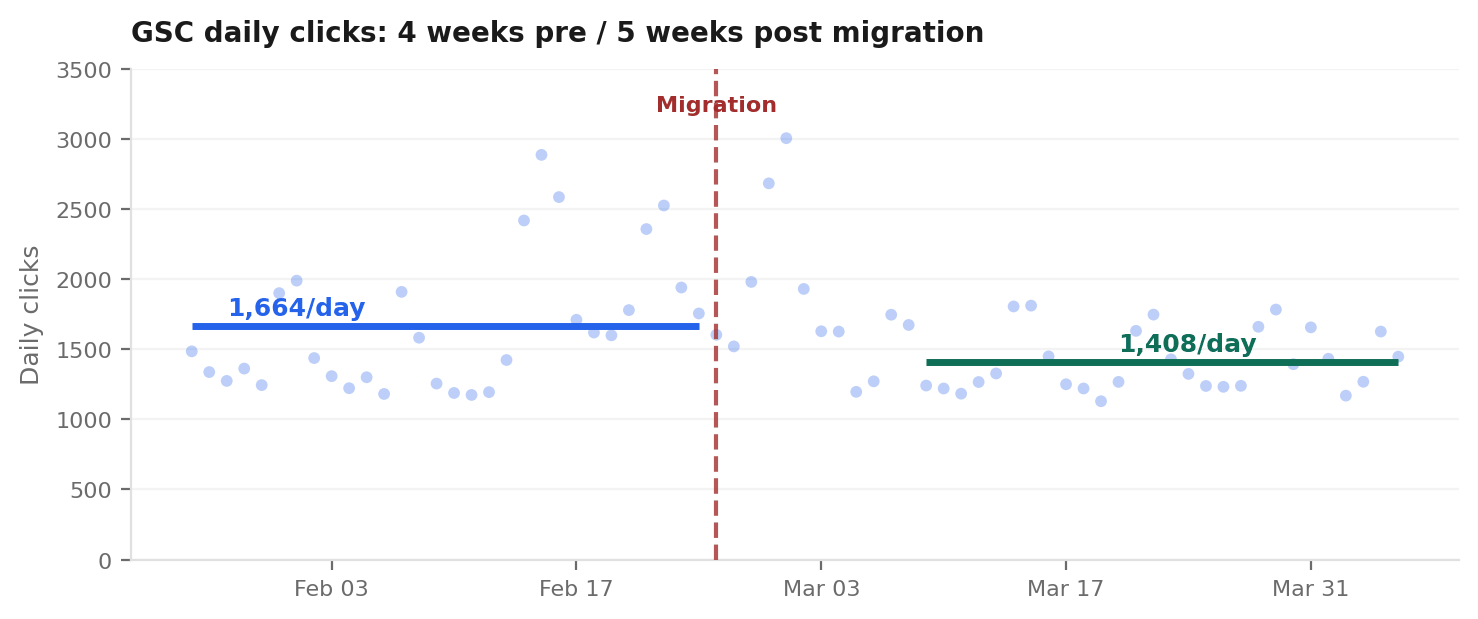
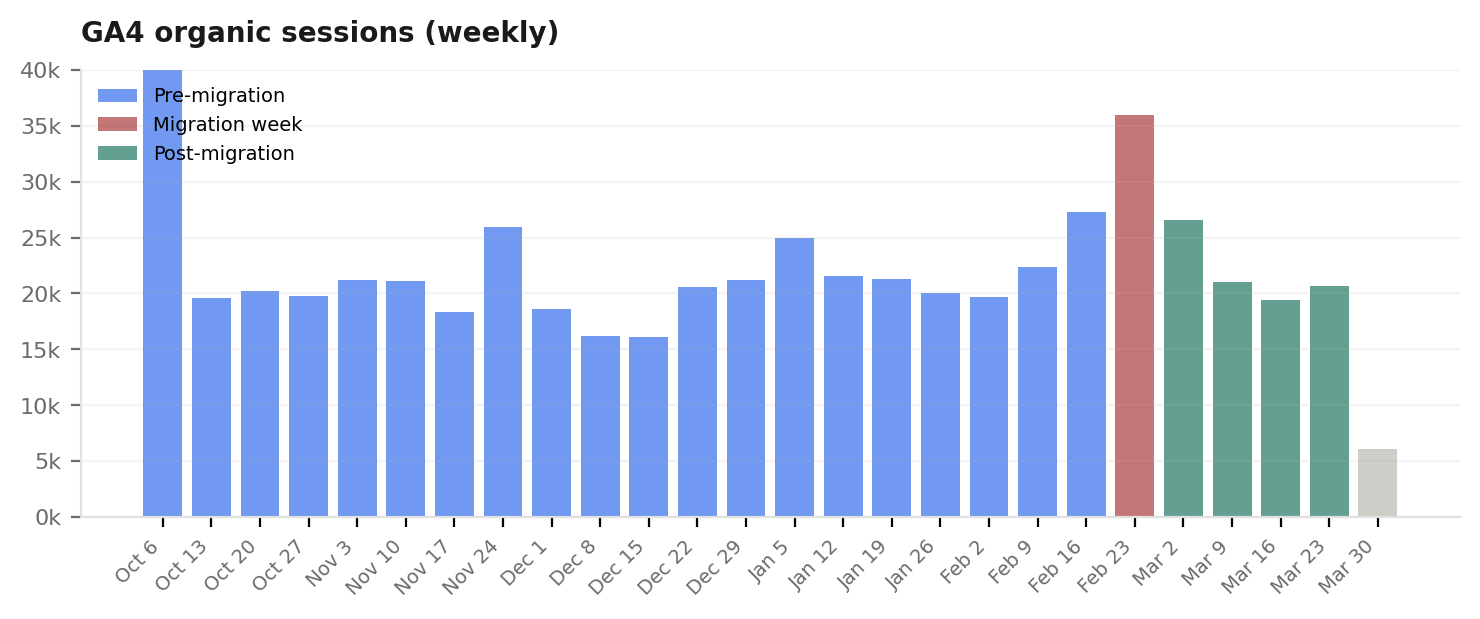
- Organic sessions held steady. 102k to 101k to 101k across the three months spanning the migration. No meaningful traffic loss.
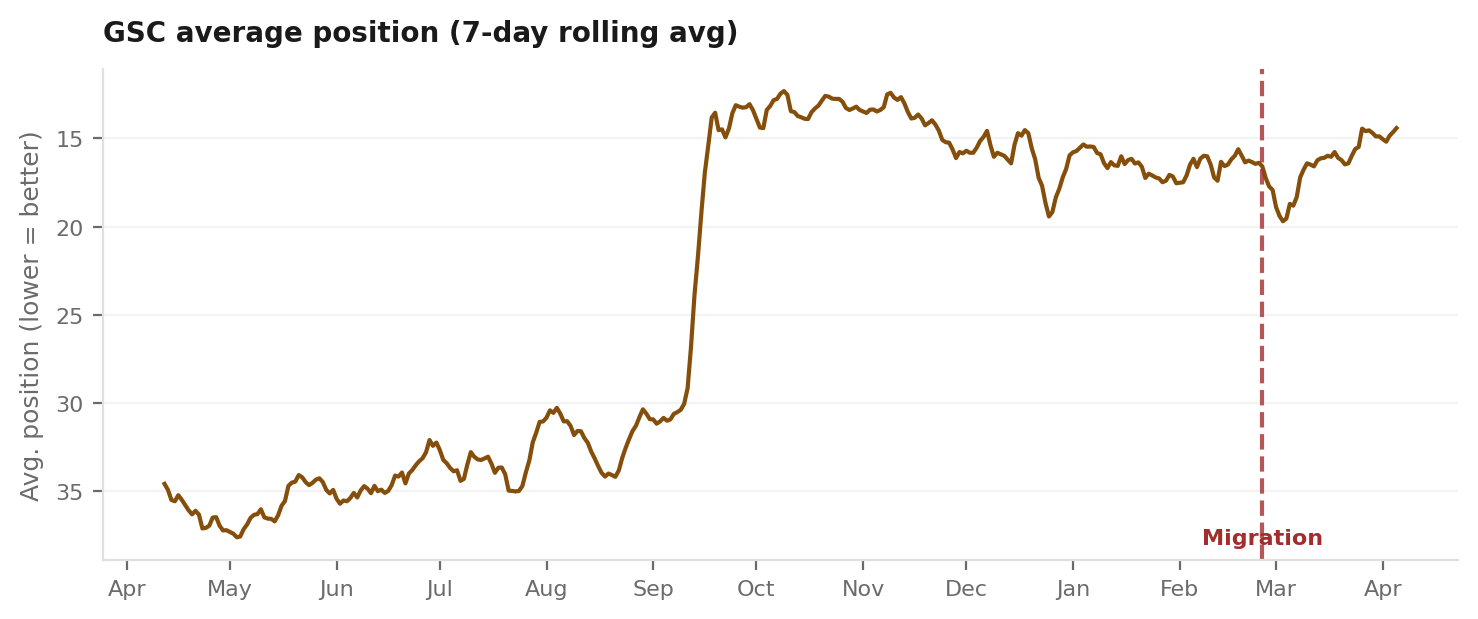
- Average position improved 1.2 points. 16.6 to 15.4. The consolidated domain was getting stronger, not weaker.
- CTR went up 6 percent. From 1.17% to 1.24%. One brand in search results outperforming two brands competing with each other.
- Migration week saw a +30% spike, not a drop. Organic sessions jumped about 30 percent during the transition as redirect traffic flowed in, then settled back to baseline.
Sunset brand equity transfer (within 5 weeks)
- Sunset brand clicks captured: 4,045
- Sunset brand impressions: 213,000
- Core brand term position: Page 1 (pos. 6)
- Location queries: Top 3
What I took away
The boring truth about migrations is that the best ones do not have a dramatic story. No heroic recovery, no “we lost 40 percent and clawed it back.” Just planning that accounted for the risks and execution that followed the plan.
The redirect prioritization was probably the single most important decision. With 6,200 URLs, you cannot give every page the same level of scrutiny. I focused on the top 200 by traffic and made sure those were bulletproof. Everything else followed the same mapping logic but got less manual validation. That tradeoff felt right and the results backed it up.
Same-platform migrations are easier, but they are not free. Even with identical URL structures and the same Shopify instance, you still have to audit canonicals, clean up sitemaps, and monitor the transition. The platform removes some variables. It does not remove the work.
And front-loading your monitoring cadence matters. Daily checks in week one catch things while they are fixable. By week three, if the signals are clean, you can relax into weekly reviews. But you have to earn that confidence with the early data.