
Enterprise Grocery CMS Migration
Outperforming benchmarks despite constraints.
Overview
- Industry: Regional grocery retail (100+ locations, upper Midwest)
- Site scale: 200,000+ URLs, ~7,400 daily organic clicks, ~375,000 daily impressions
- Migration: Full CMS platform migration to a third-party e-commerce platform
- Timeline: 5 weeks from engagement to launch
- My role: Technical SEO lead. Redirect strategy, pre and post-migration analysis, ongoing oversight.
The situation
A regional grocery chain with over 100 store locations was migrating its entire website, more than 200,000 URLs, from its existing CMS to a third-party e-commerce platform. The migration would affect product pages, store locators, weekly ad circulars, recipe content, and category navigation.
I was brought in approximately five weeks before the scheduled launch date. At that point, a redirect map already existed, but it had not been audited for SEO quality. I had no prior relationship with the platform vendor’s engineering team, no access to the new CMS environment for pre-launch testing, and no ability to influence the platform vendor’s implementation timeline.
Industry benchmarks set expectations for migrations of this scale: a 10 to 30 percent decline in organic traffic is considered normal, and recovery periods can last anywhere from one week to one year.
The challenge: ~15,000 problematic redirects
My pre-migration audit of the existing redirect map revealed three critical problems that, if left unresolved, would have severely damaged the site’s organic visibility:
- 2,950 homepage dump redirects. Google treats mass homepage redirects as equivalent to 404 errors, zero link equity transfer. Nearly 3,000 pages would have vanished from Google’s index overnight.
- 11,540 non-indexable redirect targets. 301 redirects targeting URLs blocked from indexing. Link equity built over years would be lost with zero SEO benefit.
- Unmapped high-traffic directories. Significant portions of the product and shopping directories, pages with active organic traffic, had no redirect mappings at all.
The approach
With five weeks and no leverage to change the launch date, I focused entirely on what I could control: making the redirect map as clean as possible.
Eliminated all homepage dump redirects. Removed the 2,950 rules mapping legacy URLs to the homepage. For URLs with no equivalent destination, I recommended allowing proper 404 responses, which Google handles far better than misleading homepage redirects.
Removed non-indexable redirect targets. Audited the 11,540 redirects pointing to blocked pages and removed them, preserving only redirects that pointed to live, indexable destinations.
Mapped coverage gaps in high-traffic directories. Prioritized redirect creation for indexable legacy URLs in the product and shopping sections, ensuring the highest-value pages had proper redirect paths.
Delivered a migration playbook. Documented the full pre-launch, launch, and post-launch process. Benchmarking, crawl verification, sitemap submission, analytics validation, and monitoring cadence.
The results
Immediate post-migration performance (first two weeks)
- Daily organic clicks: 8,371 to 11,861 (+41.7%)
- Daily impressions: ~286,000 to ~357,000 (+24.8%)
- CTR: ~2.9% to ~3.3% (+30.8%)
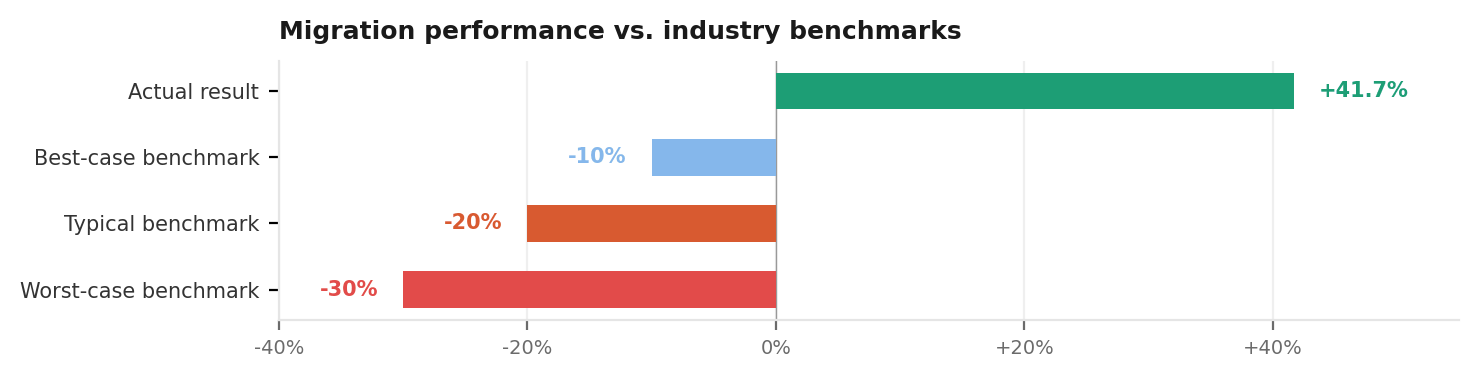
These results significantly exceeded industry benchmarks, where even a well-executed migration at this scale typically produces a 10 to 30 percent traffic decline in the initial weeks.
Post-migration technical analysis
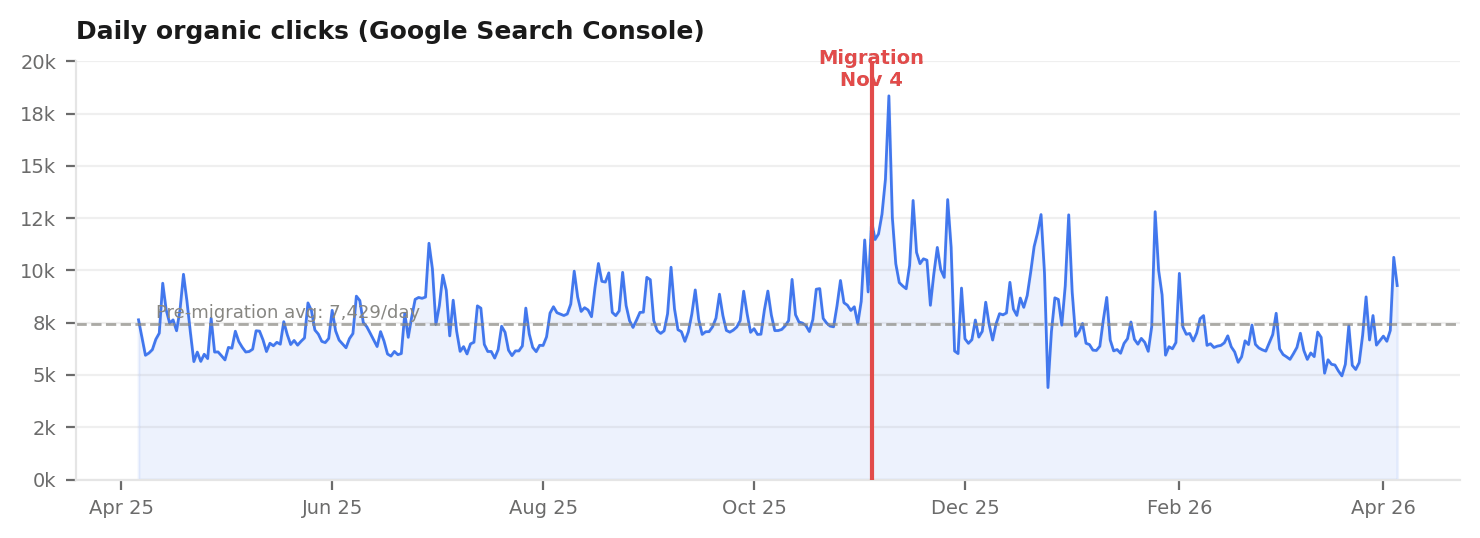
Within two weeks of launch, I delivered a comprehensive post-migration technical analysis.
Positive indicators: Zero 5xx server errors, proper 301 implementation throughout, low noindex count (22 pages), key page templates migrated with titles, headings, and content intact.
Issues flagged for resolution: A site-wide meta refresh tag causing every URL to appear as a redirect chain in crawl data, 18,000 orphaned pages lacking internal links, ~2,900 pages missing title tags or meta descriptions, ~5,200 pages missing H1 heading structure, GA4 not implemented at launch (creating a ~6 day measurement gap), and non-Google search engines and AI crawlers blocked from indexing.
The constraint that shaped everything
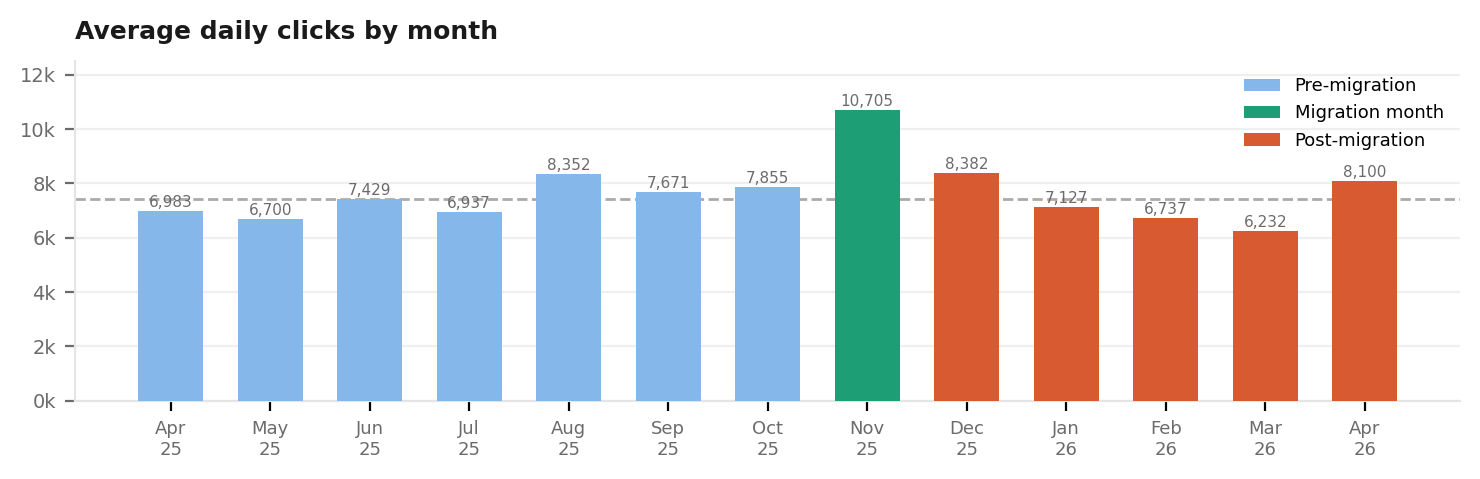
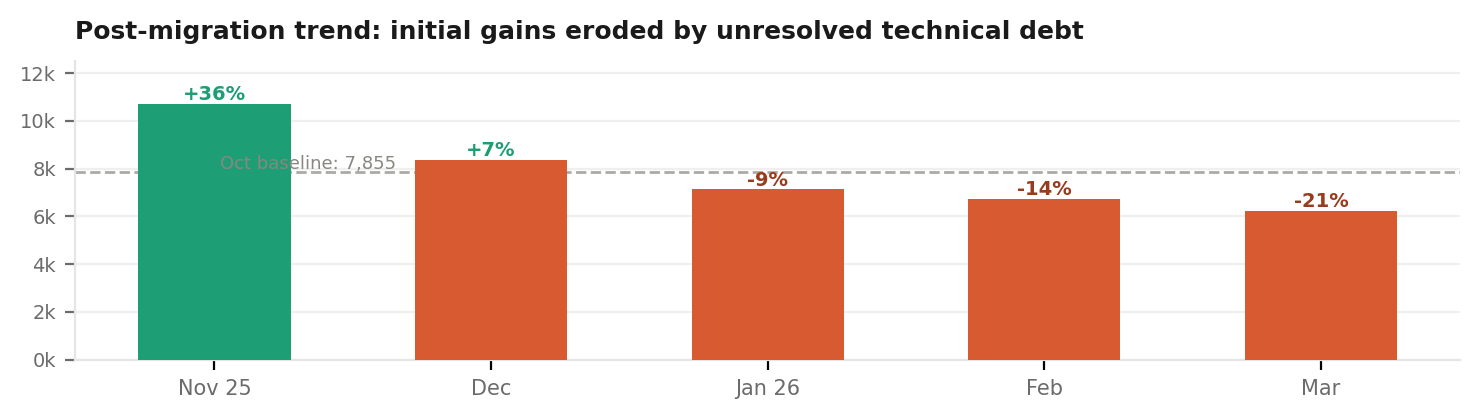
The defining challenge was not technical. It was organizational. I had no direct access to the platform vendor’s engineering team. All recommendations were communicated through the client’s internal staff. As of five months post-migration, none of the technical recommendations from either the November analysis or the January follow-up audit have been implemented.
The initial migration gains have been eroded, not by the migration itself, which was executed cleanly, but by the accumulation of unaddressed technical issues on a platform where the SEO team has no implementation authority.
Key takeaways
1. Redirect quality is the single highest-leverage intervention in a migration. Cleaning ~15,000 problematic redirects was the difference between a migration that outperformed benchmarks and one that would have produced catastrophic visibility loss.
2. Migrations are won or lost before launch day. The five-week window was tight but workable because the scope was focused. Trying to boil the ocean would have diluted focus from the one thing that mattered most.
3. A successful launch is not a successful migration. The +41.7% click increase in the first two weeks was a genuine win, but it was the beginning of the migration, not the end. Migration success should be measured at 6 to 12 months, not 2 weeks.
4. Access to the implementation layer determines long-term outcomes. The most thorough audit in the world has zero impact if recommendations cannot reach the team that controls the codebase.
Tools used: Screaming Frog SEO Spider, Google Search Console, Ahrefs, SEMrush, Google Analytics 4, Power BI.